Porting the RAD Debugger to macOS
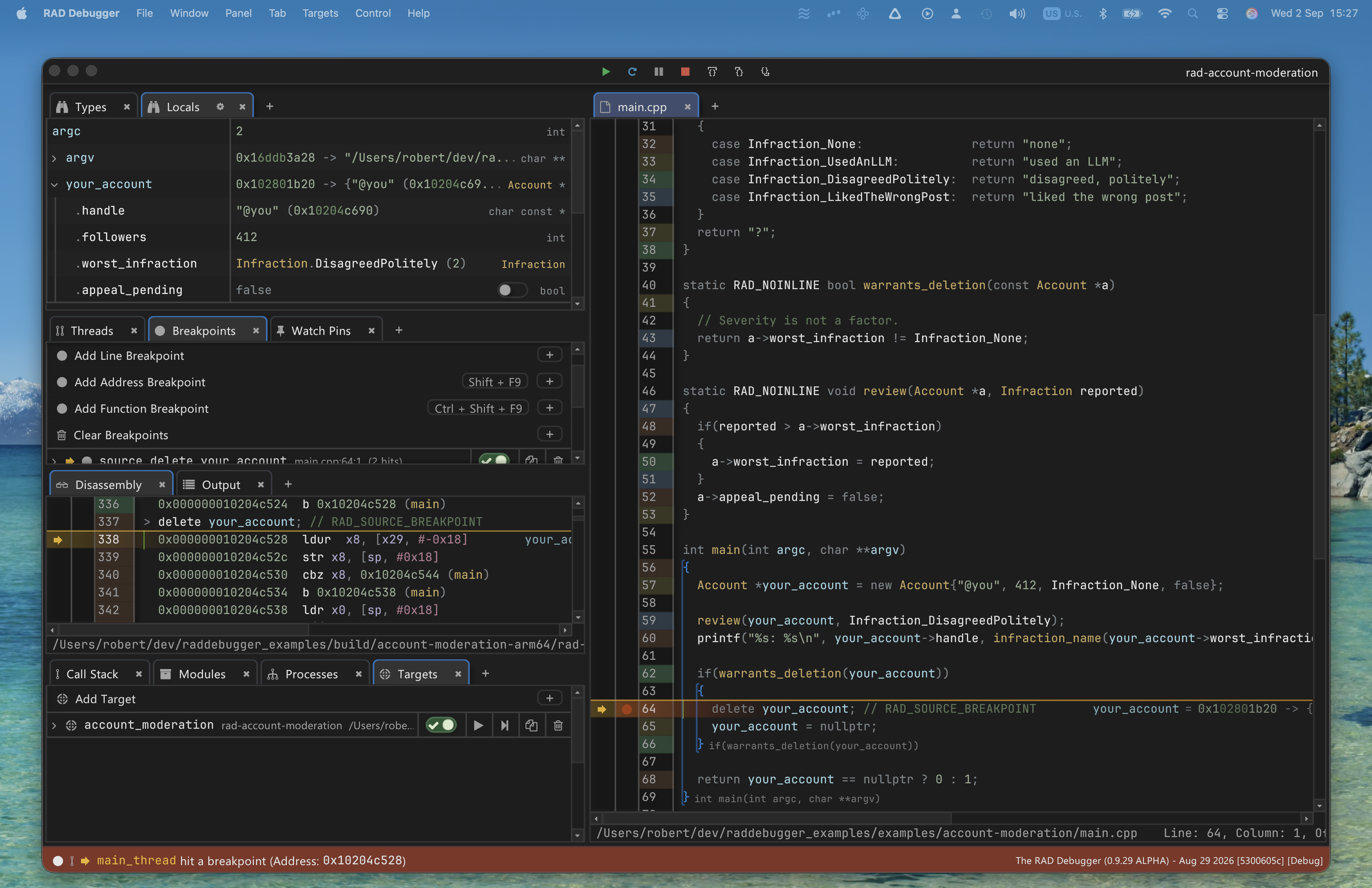
The port itself, with a branch-by-branch breakdown, is at robert.wittams.com/raddebugger.
Why do this?
I wanted to:
- See what all the fuss was about with this debugger - all the good debuggers are on Windows apparently! I was also interested in the immediate mode gui style and how that was pulled off for a quite involved interface.
- Refresh on assembly and low level development - I’ve known C and assembly for 30+ years - but I don’t do it all the time.
- See how far I could push agents on this kind of work, and how much of a productivity boost they can provide.
- Come up with a workable model for ‘long-lived personal forks’ - I haven’t fully achieved this yet, but I believe it is where software is going. I have a few more of these I may write up later.
I don’t really expect this to be upstreamed and that is fine! I didn’t quite realise how strong the anti LLM sentiments were amongst some in the community, so this is provided as is.
How the port was made
I broke down the work into architectural layers that could be proven end to end. Most of the work was produced using GPT-5.3-codex and GPT-5.5 in codex cli.
- The work was interactive, not fire-and-forget (factory style).
- HTML explorations of the codebase (and sometimes changes) were produced using Claude Design (Opus 4.6 onwards). This was helpful to navigate unfamiliar areas and visualize things.
- I did research using the sources below.
- I used the debugger to manually test (after it was bootstrapped to roughly working).
- Often, agents were unreliable on precise semantics until given a verification
loop — driving the debugger with its own commands, gui interactions (enhancing the debugger cli interface to allow this).
I used some of my existing tools for this to let the agents do platform comparisons (intel vs arm, mac vs linux/windows):
Some work was done by hand:
- Trapping machinery
- Some tricky parts of demon control
- Some metal shader work
- Probably others I’ve forgotten
These parts just turned out to be easier to think about/specify in code at the time. Probably totalling less than 1500 lines.
The initial x86 port took about five days; ARM64 about three more - in May 2026. Everything since: debugging, and maintenance against a moving upstream, takes maybe 0.5-1 days a month.
Reading the code
For some projects or stages in development, code reading is no longer strictly required: prototyping, ‘code as content’. Possibly, if you have good enough testing or formal verification in place this can be extended to more involved projects. For this particular project, I find it necessary to read the code - to notice what is going wrong - especially for things that don’t yet have a verifiable signal.
Common agent mistakes on this project:
- Getting confused about line endings - the codebase is mixed CR/LF and LF
- Falsely attributing comments to the upstream author, or removing attribution
- Editing generated files rather than regenerating
- Some confusion with very long functions - but most of the time compiler error signals are enough to deal with that.
Deterministic checks for some of these were either added or are planned.
Of course, more ‘one off’ bugs/mistakes are found by reading the code too.
Rippling the DAG
The port is maintained as a DAG of subject specific branches, somewhat like a traditional patch set. They culminate in an integration branch. The branches are prefixed by a generation - e.g. mac8. I have some Python tooling oriented around maintaining this DAG through two operations:
- Fixes from on top of the integration branch are distributed to the appropriate places in the DAG.
- Upstream moves beneath the DAG.
How a ripple actually runs
When an earlier branch changes, the change ripples through every branch after it; the generated joins are recreated from their inputs, never committed to. A manifest records the intended graph, and tooling checks Git ancestry against it before and after each session. A generation move (usually an upstream refresh) is the same operation: the whole DAG is rebuilt against a new pinned upstream base (the previous generation is archived intact).
Fixes found at the integration tip are batched there and rippled deliberately, and a ripple must end with an empty diff against the tested tip.
Testing is then done on various machines by agents through the ipc interface.
Patch-set history is not currently ideal. A branch keeps its identity
across generations - mac7/mac/appkit-shell and mac8/mac/appkit-shell
are the same idea, but with unrelated commits. git range-diff can compare two versions
of a series; jj change IDs survive rebases within a repository,
but not a re-derivation.
This work I have found doable in a factory style, as it is quite a repeatable pattern that is being followed.
Planned:
- separate the DAG tooling from this fork so it can be used to maintain other long-lived forks
- abstract it enough from Git to try jj or other SCMs.
Assessment
My finger in the air assessment is that this would have taken me around 2 months without agents. Totally doable - but would I have done it? I doubt it. Humble-braggingly I will concede this is mainly a tick in the ‘agents amplify those who already know what they are doing’ column.
On the debugger - it is good, and fun to use. I still think Java debuggers are slept on by many though, in terms of features/ease of use! There are still a lot of gaps here vs every feature of gdb/lldb, but it is much nicer to use than those and the wrappers I’ve used recently. The one feature I do miss from IntelliJ is dependent breakpoints - I may well add that (portably of course). Remote debugging and separation of debugger and target architecture are clearly possible, but will need quite a bit of surgery - not something for this port!
What I might do differently if re-running this port:
- Give the debugger an ipc surface compatible with other debuggers test suites (e.g. lldb Dexter)
- Possibly look into prop-test like code and ‘debugging situation’ generation - a Bombadil ui driver will be interesting eventually. Csmith-style generation could cover the target programs themselves.
- Generally - increase the ease with which agents can get feedback. Its probably worth doing this on the original platform first - I bootstrapped the debugger on mac os before doing any of this (or running it on windows/linux!)
References
- Maria Markstedter, Blue Fox: Arm Assembly Internals and Reverse Engineering.
- The Arm Architecture Reference Manual for A-profile.
- Jonathan Levin, *OS Internals.
- Ryan Fleury’s series on the debugger’s internals.
- The XNU and LLDB sources, occasionally.